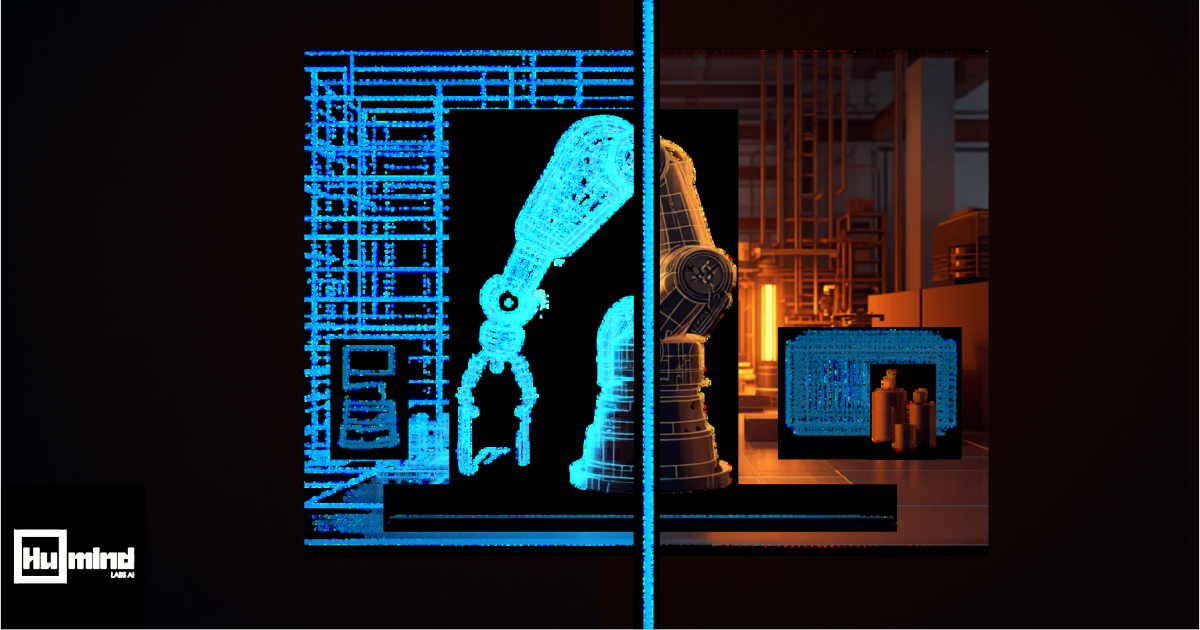
A robot trained entirely on simulation data just outperformed a model built on millions of real-world human demonstrations. Here is what that means — and why it changes the economics of building intelligent machines.
The Rule That Just Got Broken
For most of the history of robotics research, a single constraint shaped everything: if you wanted a robot to learn a task, you had to show it that task in the real world. A human would strap on a control harness, guide the robot’s arms through each motion hundreds of times, and then hope the system could generalize to objects and environments it had not seen before. It was expensive, slow, and fundamentally hard to scale.
This constraint had a name in the research community: the sim-to-real gap. Simulations, the thinking went, were simply too artificial. Physics engines could not replicate the full complexity of friction, lighting variation, deformable objects, and sensor noise well enough for a policy learned in a virtual world to transfer cleanly to a physical one. Simulation was useful for rapid prototyping, not for training robots you planned to deploy.
In March 2026, that rule broke.
What MolmoBot Did
On March 17, researchers at the Allen Institute for AI (Ai2) — the non-profit lab behind the open-source Molmo vision-language models — submitted a paper to arXiv with a result that stopped the robotics community: a robot policy trained with zero real-world data achieved a 79.2% success rate on real-world pick-and-place tasks, compared to 39.2% for π₀.₅, the flagship model from Physical Intelligence that was trained on a large-scale dataset of real human teleoperation demonstrations.
Read that again. A model that has never seen a real robot environment outperformed a model that was trained on expensive, human-collected demonstrations — by more than double.
The system is called MolmoBot, and it is built on three components:
MolmoBot-Engine: A fully open-source procedural data generation pipeline built on the MuJoCo physics simulator. It generates training environments by randomly sampling object types, positions, lighting conditions, camera viewpoints, and surface textures. The diversity is deliberately extreme — the system produced trajectories across 11,000 unique objects and 94,000 procedurally generated environment configurations.
MolmoBot-Data: The resulting dataset of 1.8 million expert trajectories spanning eight task categories, including pick-and-place on tabletop surfaces, door opening, drawer manipulation, and cabinet interaction — all across two different robot platforms (the Franka FR3 arm and the Rainbow Robotics RB-Y1 mobile manipulator).
MolmoBot (the policy model): A vision-language-action (VLA) model built on Ai2’s Molmo2 backbone that processes sequences of RGB camera frames and natural language instructions to produce robot actions.
Critically, the model operates on RGB images only — no depth cameras, no privileged simulator state, no special sensor rigs.
Why This Works: The Diversity Hypothesis
LLMs generalize because text is combinatorially diverse. The training distribution for GPT-3 encompassed scientific papers and Reddit arguments and Shakespearean sonnets and Python code — an enormous range of contexts, styles, and domains. When you encounter a new prompt, there is almost always enough structural overlap with something the model has seen before.
MolmoBot’s bet is that this was an engineering problem, not a fundamental limit. Generate enough diverse synthetic environments — 94,000 procedural variations, 11,000 unique objects, systematic randomization of every visual variable — and the robot policy’s training distribution becomes combinatorially rich enough to generalize, just as text diversity enabled LLMs to generalize.
The NVIDIA Parallel: GR00T N2 and a New Compute Paradigm
The same week MolmoBot appeared on arXiv, NVIDIA’s GTC 2026 conference introduced GR00T N2, the next generation of NVIDIA’s open foundation model for physical AI.
Where MolmoBot focuses on zero-shot sim-to-real transfer for manipulation tasks, GR00T N2 represents NVIDIA’s broader architectural bet: a World Action Model that tightly integrates world simulation with policy generation. The model is trained using NVIDIA’s Cosmos 3.
GR00T N2 currently ranks first on the MolmoSpaces benchmark and on RoboArena. NVIDIA claims that robots running GR00T N2 complete new tasks in unfamiliar environments more than twice as often as leading vision-language-action models.
The ecosystem also includes Isaac Lab 3.0, the Newton Physics Engine 1.0, and commercial partnerships with robotics companies including 1X, Boston Dynamics, and Figure, alongside industrial robot manufacturers FANUC, ABB, YASKAWA, and KUKA.
A Useful Analogy: The Flight Simulator Threshold
Early flight simulators in the 1940s and 50s were so crude that regulators rightfully refused to count simulator hours toward certification. Over decades, simulator fidelity improved. At some point in the 1990s, aviation authorities crossed a threshold: simulators became accurate enough that pilots certified entirely on simulators performed as well as those with equivalent real flight hours.
The robotics field is crossing that same threshold now. Not because physics engines have finally achieved perfect physical fidelity. The threshold was crossed because procedural diversity at sufficient scale turns out to be more important than fidelity.
Fidelity was the wrong variable to optimize. Diversity was the right one all along.
What This Means for Enterprises
On cost: MolmoBot-class approaches invert the traditional model. The expensive part — environment and trajectory generation — runs in simulation on compute hardware. Real robot time becomes a validation step, not a training step.
On accessibility: Both Ai2 and NVIDIA are releasing their tools openly. The MolmoBot-Engine and MolmoBot-Data dataset are open-source. NVIDIA’s Isaac Lab 3.0 is available in early access.
For SMBs in manufacturing, logistics, and food processing, the relevant question is not whether to engage with physical AI, but how soon the deployment cost curve falls to your accessible range.
According to Dynatrace’s “Pulse of Agentic AI 2026” survey, 50% of enterprise AI projects have reached production for at least limited use cases, and 23% have achieved mature enterprise-wide integration.
Risks and Limitations Worth Naming
Task scope is still narrow. MolmoBot’s 79.2% result is on pick-and-place and articulated object manipulation tasks in controlled evaluation settings.
Domain randomization has a ceiling. Highly unusual real-world conditions may still produce transfer failures.
Evaluation benchmarks are young. MolmoSpaces and RoboArena are relatively new community standards.
Compute requirements are not trivial. Generating 1.8 million synthetic trajectories requires meaningful GPU infrastructure.
Conclusion: The Bottleneck Has Moved
The sim-to-real gap was not eliminated. It was outpaced. The bottleneck for robot learning has moved from “how do we collect more real-world data” to “how do we build better virtual worlds” — a question that can be scaled with compute, open infrastructure, and the same engineering principles that drove the LLM revolution.
Discussion question for readers: If the cost and complexity of robot policy training dropped to the level of fine-tuning a language model, which physical processes in your business would you automate first?
References
1. Deshpande, A., et al. (2026). MolmoB0T: Large-Scale Simulation Enables Zero-Shot Manipulation. arXiv:2603.16861.
2. Allen Institute for AI. (2026). MolmoBot: Training robot manipulation in simulation. https://allenai.org/blog/molmobot-robot-manipulation
3. Bjorck, J., et al. (2025). GR00T N1: An Open Foundation Model for Generalist Humanoid Robots. arXiv:2503.14734.
4. The Decoder. (2026). GTC 2026: Nvidia wants to swap robotics data problem for a compute problem. https://the-decoder.com/gtc-2026-nvidia-wants-to-swap-robotics-data-problem-for-a-compute-problem/
5. Dynatrace. (2026). The Pulse of Agentic AI in 2026. https://dynatrace.com/info/reports/the-pulse-of-agentic-ai-in-2026/
Ready to make your software AI-operable?
Tell us your most painful manual process. We'll show you what an agent-ready version looks like — and how long it would take to ship.